Cheltenham Borough Council (CBC) is facing one of the biggest changes to local government in a generation. National reform means that Cheltenham Borough Council will be replaced by a much larger unitary authority, or authorities, covering a wider area than the borough alone. The government is now consulting on which option communities prefer. To find out more about this Local Government Reorganisation (LGR), please visit our devolution and local government reorganisation information page.
No matter what the future might look like for Cheltenham Borough Council, we want to make sure we keep and improve community engagement and cohesion; local democracy; civic pride; and the delivery of effective local services. This Community Governance Review (CGR) will help inform us on the model that we can use to do this. A CGR is a legal process that gives residents and organisations the chance to share their views on the most suitable ways of representing the people at a community level.
The main purpose of this review is to understand whether there is support for setting up any new town or parish councils in the borough or whether any of the existing parish councils of Charlton Kings, Leckhampton with Warden Hill, Prestbury, Swindon Village or Up Hatherley wish to amend their existing boundaries.
Stage one consultation: Gathering your views (19 May - 18 July 2025)
During the stage one consultation we asked for your initial feedback on what works well and what could be improved. We invited suggestions for changes to parish councils, such as boundary changes, mergers, or governance improvements or suggestions that new parish or town councils are set up.
The first stage generated several proposals:
To complete a full review of the boundaries of Swindon Village Parish and Prestbury Parish, including Wyman’s Brook to establish which parish it should sit in
To complete a full review of the unparished area between Prestbury and Charlton Kings to understand if it should be incorporated into one of the already established councils
To consider setting up a new parish for Benhall and The Reddings
To directly ask the public, if they would like to see a town council in Cheltenham
To complete a full review of the Leckhampton and Warden Hill Parish to understand whether the existing parish should be extended and/or separated into two parishes
We are now beginning further work on the requested parish boundary reviews which will include preparing options for further consultation. Local engagement with affected communities will take place as those options are developed. Consultation is likely to take place in April-May 2026.
Stage two consultation: Your views on a town council for Cheltenham (24 February to 29 March 2026)
At stage two of the process we asked residents for their views on whether Cheltenham should have a town council.
Overall there was a positive response to the idea of creating a new town council for Cheltenham town centre.
Stage three consultation: Boundary options for town and parish councils (22 June to 31 July 2026)
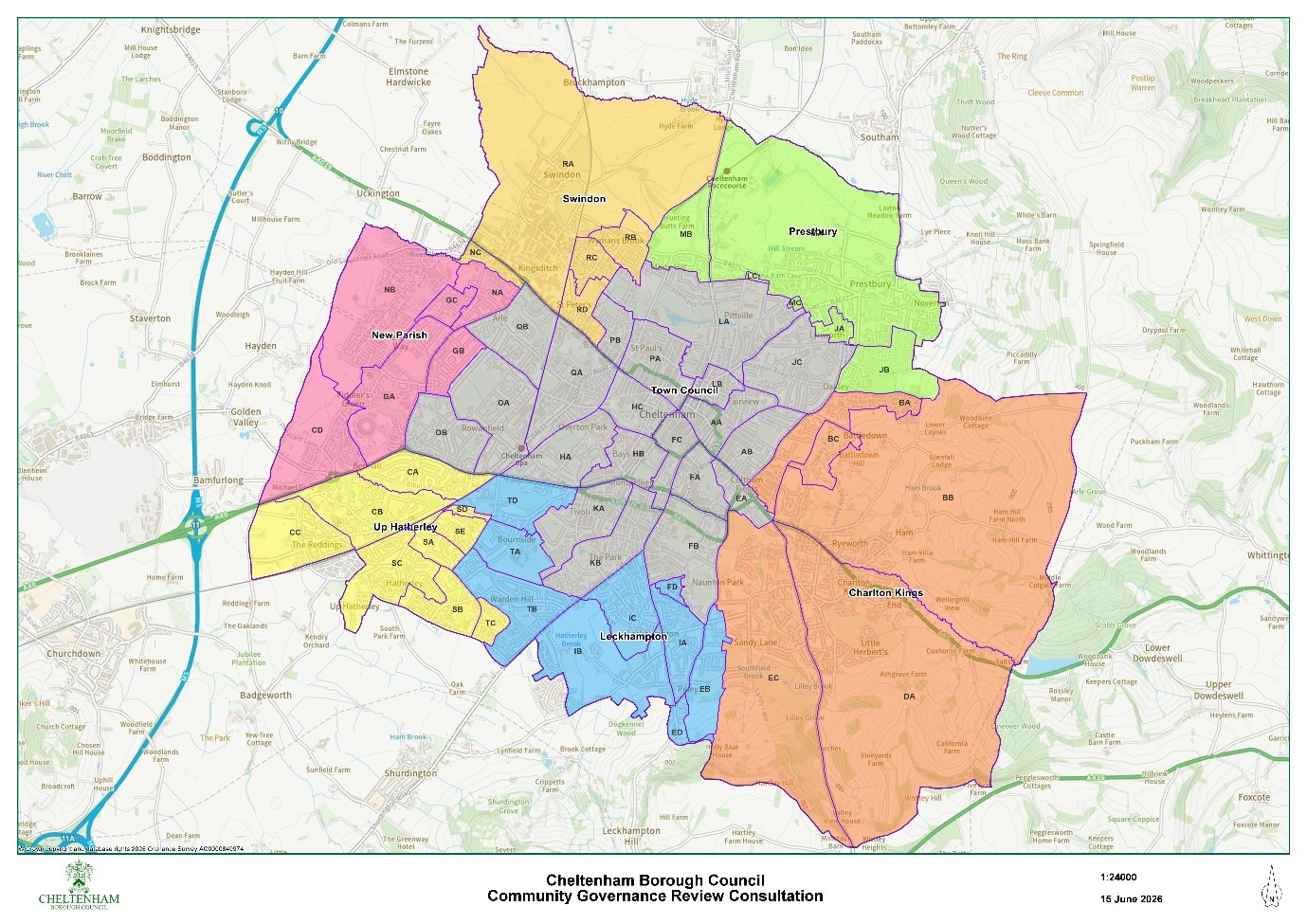
We are now embarking on a third stage of consultation to look at the possible options for the boundaries for the town council and also the proposed boundary changes for the other five existing parishes and the possible creation of new parished areas.
We are seeking views on the proposals as set out in Map 2 below.
For administrative reasons any new parish/town council boundaries must follow the existing polling district boundaries which are indicated on Map 2 below.
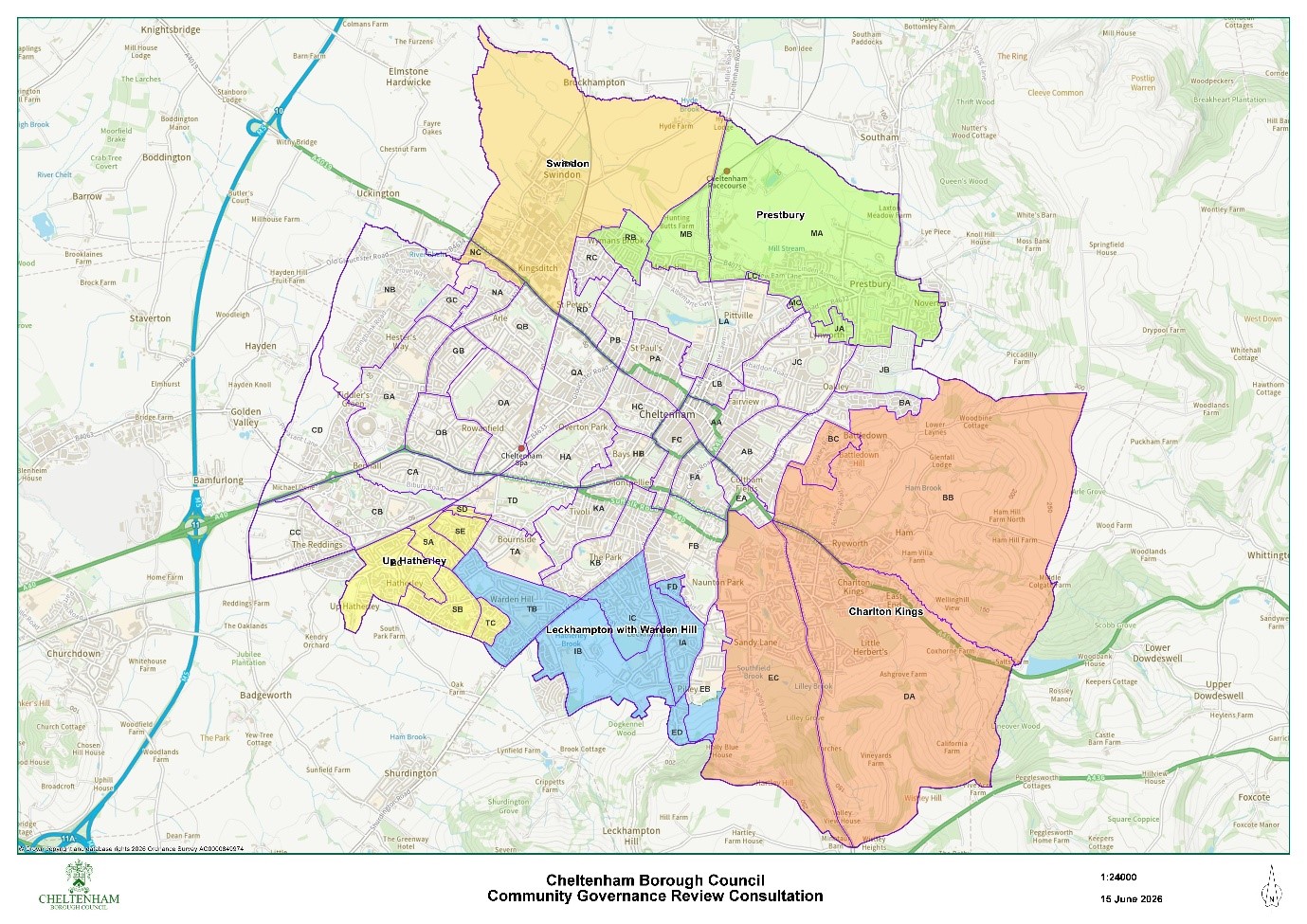
Map 1 - Existing parish boundaries
Map 1 - Click or tap to view full size (opens in new tab/window)
Map 2 - Proposed new parish and town council boundaries
Map 2 has been drawn up having regard to the consultation feedback at Stage 1.
Map 2 - Click or tap to view full size (opens in new tab/window)
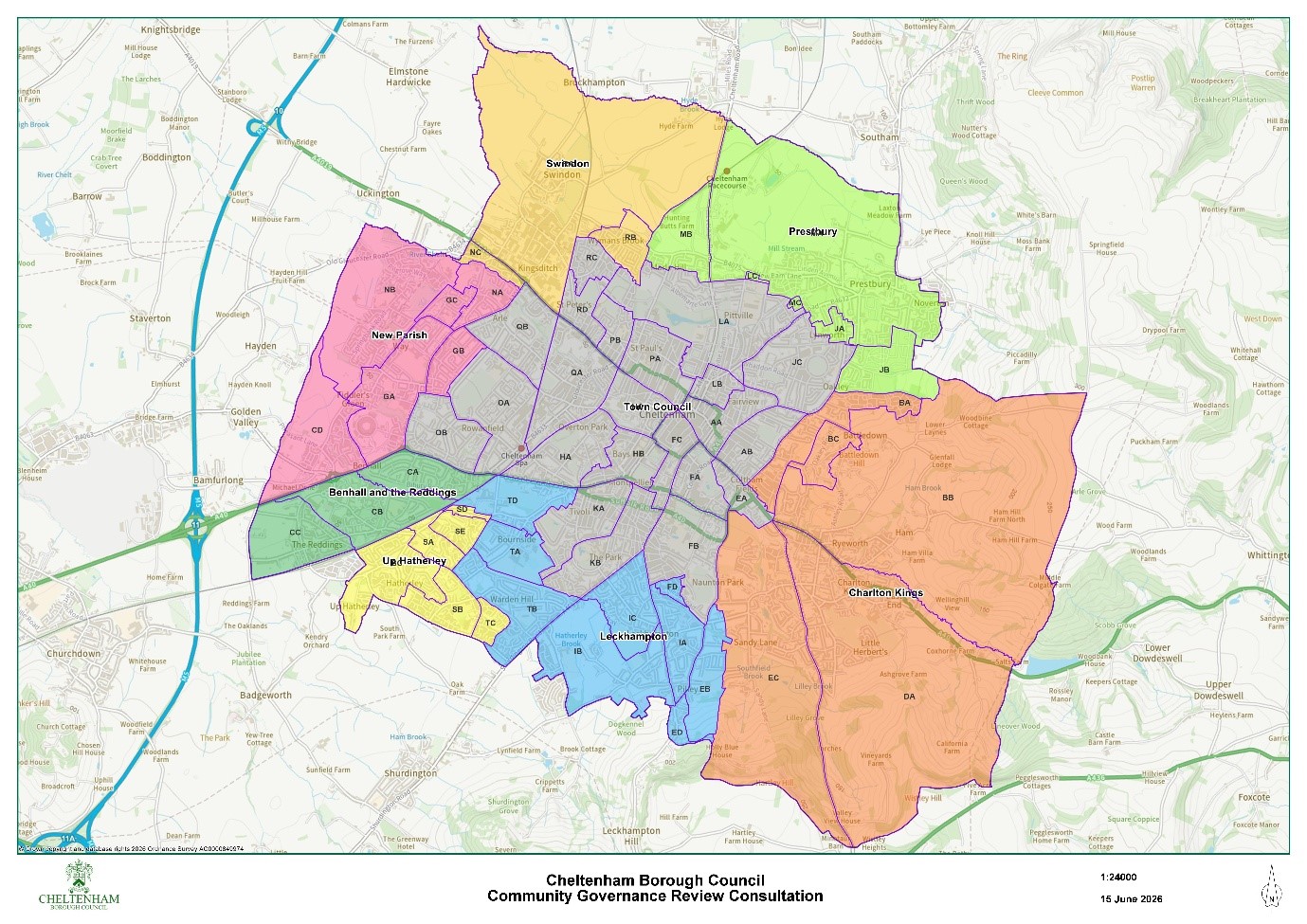
Map 3 - Alternative boundaries
Map 3 has removed polling districts RC and RD from Swindon Village Parish and included them in the proposed new town council. It also shows polling districts CA, CB and CC as a separate parish rather than being included within the Up Hatherley Parish Council boundary.
Map 3 - Click or tap to view full size (opens in new tab/window)
How to respond to the consultation
Please provide your feedback on the proposals by completing the online consultation form. This consultation closes on 31 July 2026 at 5pm.
Alternatively, paper copies will be available at the following locations during the opening times listed.
Municipal Offices, Promenade, Cheltenham – open Monday, Tuesday, Thursday and Friday: 9am to 5pm and Wednesday: 10am to 5pm
Charlton Kings Parish Council, Church Piece, 26 Church Street – open 10am – 2pm Monday to Friday
Prestbury Parish Council - The Pavilion, New Barn Close, Prestbury, Cheltenham, GL52 3LP – open 9am to 12 noon Monday to Friday
Leckhampton with Warden Hill:
The Dug out Cafe, Burrow's Field, Leckhampton Moorend Grove, Cheltenham GL53 0HA - Open Wednesday, Thursday and Friday from 8:30am till 4pm, Saturday and Sunday 9am till 4pm
Sadars Cafe, Salisbury Avenue, Warden Hill 85 Salisbury Ave, Cheltenham GL51 3DA - Open Monday to Saturday 8am till 3pm
Oakley Community Resource Centre, Clyde Crescent, open Monday to Thursday 10am – 2pm.
Hesters Way Community Resource Centre, Cassin Drive, Cheltenham, GL51 7SU, open Monday to Friday, 8am to 6pm
Springbank Community Resource Centre, Springbank Way, Cheltenham, GL51 0LH, open Monday to Friday 8am to 6pm