Housing, Homelessness and Rough Sleeping Strategy 2023-2028
Cheltenham Borough Council’s housing, homelessness and rough sleeping strategy outlines the council’s key housing priorities, focusing on:
- delivering more affordable homes for local residents
- making best use of existing accommodation
- preventing and tackling homelessness
- improving the overall health and wellbeing of our communities

The strategy has been developed through engagement with a range of internal and external stakeholders and builds on the learning from the previous Housing, Homelessness and Rough Sleeping Strategy (2018-2023). This strategy reflects key challenges the council faces when seeking to meet local housing needs.
We also publish a yearly Action Plan to support the delivery of the Housing, homelessness and rough sleeping strategy. This plan reflects the council’s progress against each of our key priorities.
What is affordable housing?
Affordable housing is defined by the government as housing for sale or rent, for those households whose needs are not met by the market. This can include residents seeking a subsidised form of home ownership, as well as housing for essential local workers.
Why do we need the Housing, homelessness and rough sleeping strategy?
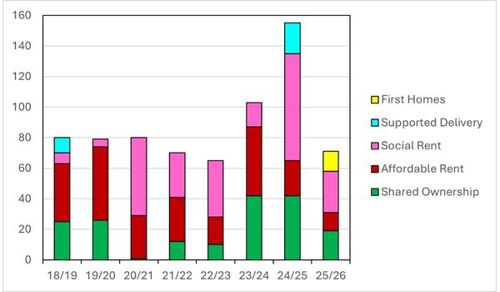
During 2025/26, the council and our housing association partners delivered 74 affordable homes across Cheltenham Borough. 39 of these were provided as social and affordable rented homes to households on our housing register.
Our latest housing need figures show that as a minimum, Cheltenham should deliver 194 affordable homes per year to meet housing need.
Whilst this is a challenging target in view of current market conditions, national policy and affordability pressures, we are determined to work with key partners to ensure that affordable housing need is met.
As of May 2026, the council recorded 2,434 households on our housing register who were seeking to move into a rented affordable home. 31% (759) of these households were in moderate (Silver band) or high (Gold band) housing need. This shows that the demand for affordable housing continues to far outweigh available supply within our borough.
For residents seeking to buy their own home (especially low-income buyers and first-time buyers), the local housing market remains challenging, with high prices and high demand for a limited supply of affordable home ownership options or cheaper market housing. Land Registry data shows that Cheltenham’s average house price as of March 2026 was £327,380, with average first-time buyers paying approximately £273,245 for their first home.
We recognise that delivering affordable homes of all tenures is crucial to support the health, wellbeing and resilience of our communities.
Creating sustainable communities is another key corporate priority for the council. The housing strategy provides a framework for the council to identify how we can achieve this objective, working alongside internal teams and external partners to help foster cohesive neighbourhoods where all residents can thrive.
How are we delivering against the Housing, homelessness and rough sleeping strategy?
The Housing strategy action plan outlines the council’s progress, working with key stakeholders across the borough, against each of our key priorities within the 2023-2028 Housing, homelessness and rough sleeping strategy.
The 5 key priorities outlined within this plan are:
- Priority 1: We will increase our provision of quality, sustainable and affordable housing
- Priority 2: We will make best use of our existing housing, improving the quality of homes and reducing carbon emissions
- Priority 3: We will tackle homelessness and the causes of homelessness
- Priority 4: We will seek to prevent rough sleeping; and when it occurs, ensure that it is rare and non-recurring
- Priority 5: We will invest in our communities to help make them safer, stronger and healthier
The councils’ progress against each of these priorities, and our measures of success are set out in the action plan, which is updated annually and scrutinised by the council’s Cabinet.
Over the period of the previous strategy (2018/19-2022/23), 374 affordable homes were delivered across the borough, 211 of which were provided as rented homes supporting households on the council’s housing register.
Over the course of the current strategy (2023/24-2025/26), 332 affordable homes have been delivered to meet local housing need (averaging 110 completions per year).193 of these homes were provided as rented homes to help house local residents on the council’s housing register. The chart below shows affordable housing delivery by tenure (different types of affordable housing) completed in Cheltenham Borough between 2018/19 and 2025/26.